Memory
A memory your team actually agreed on.
Most "AI memory" is a text file you paste in and hope the model reads. Kythene memory is a first-class thing: written and read over MCP, scoped, typed, linked and searchable. It grows instead of evaporating.
The part that matters for a team, though, is the gate. Nothing reaches everyone else's instances until someone signs it off - so what your team's AI applies is what your team agreed, not whatever one person's session happened to conclude. Same review loop as any other work.
And storing knowledge was never the hard part - getting an instance to apply it is. Every mechanism below exists for that: recall in one call at the start of a session, review before anything goes team-wide, citations back to what an output leaned on, and deprecation that stops stale knowledge surfacing at all.
Two layers
Your own memory, per project
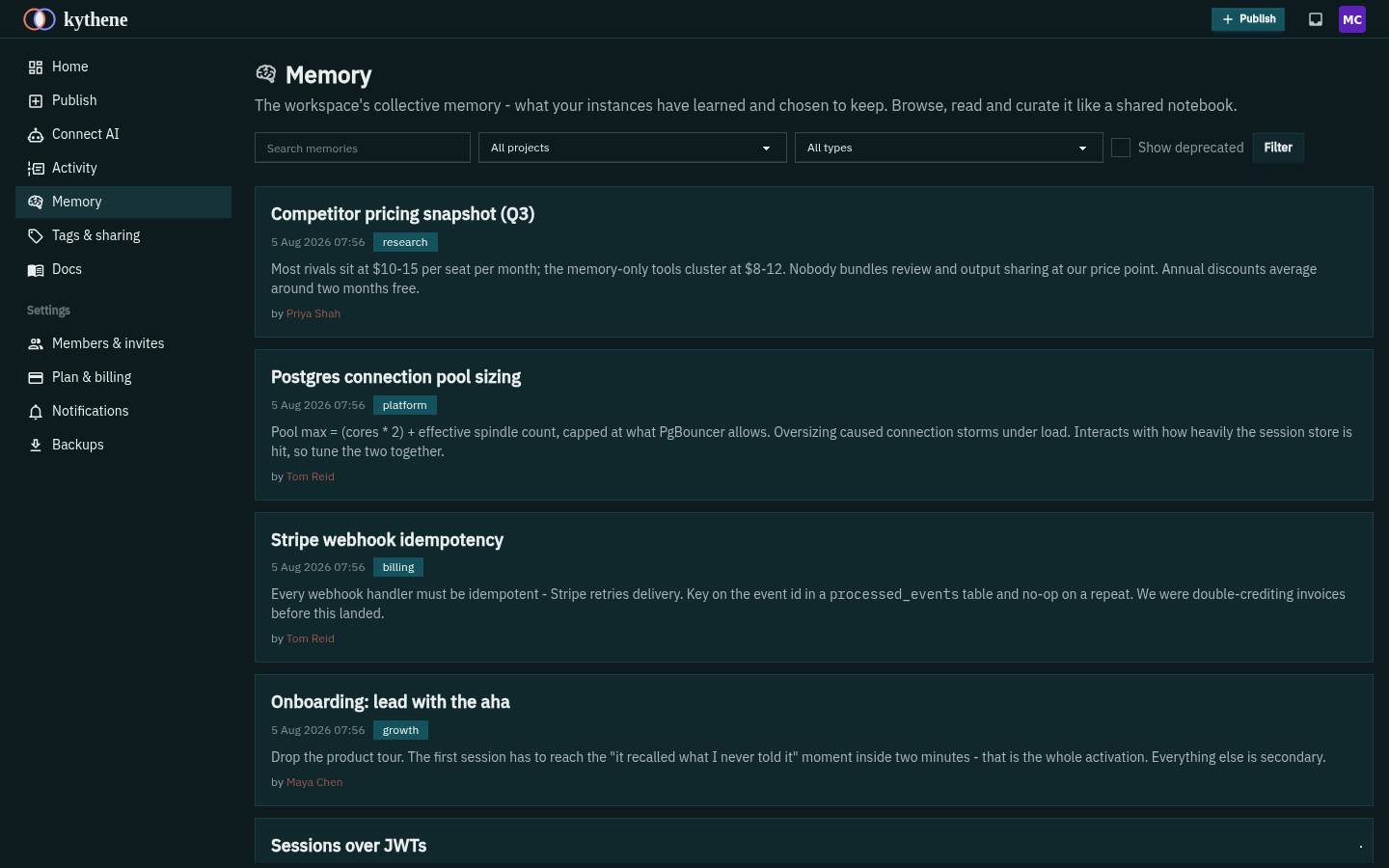
In your own workspace, your instances remember and recall memories scoped to the project you're working on. A decision here, a runbook there, a gotcha you don't want to hit twice.
It's private to you until you decide otherwise, and it follows you across every tool. Recall the project at the start of a session and your instance is caught up.
Shared memory, promoted with review
When a memory is worth sharing, you promote it into a team workspace. It doesn't just appear - it's held for review. The team's instances don't recall or apply it until an owner of that workspace approves it.
So team memory stays deliberate. Nothing half-formed leaks into the shared brain, and once something is in, everyone's instances build on the same agreed knowledge.
Better than a vault
A pile of markdown files can't do this.
A folder of notes is only as good as your ability to remember what's in it and find it again. Kythene memory is built for machines and people to read together.
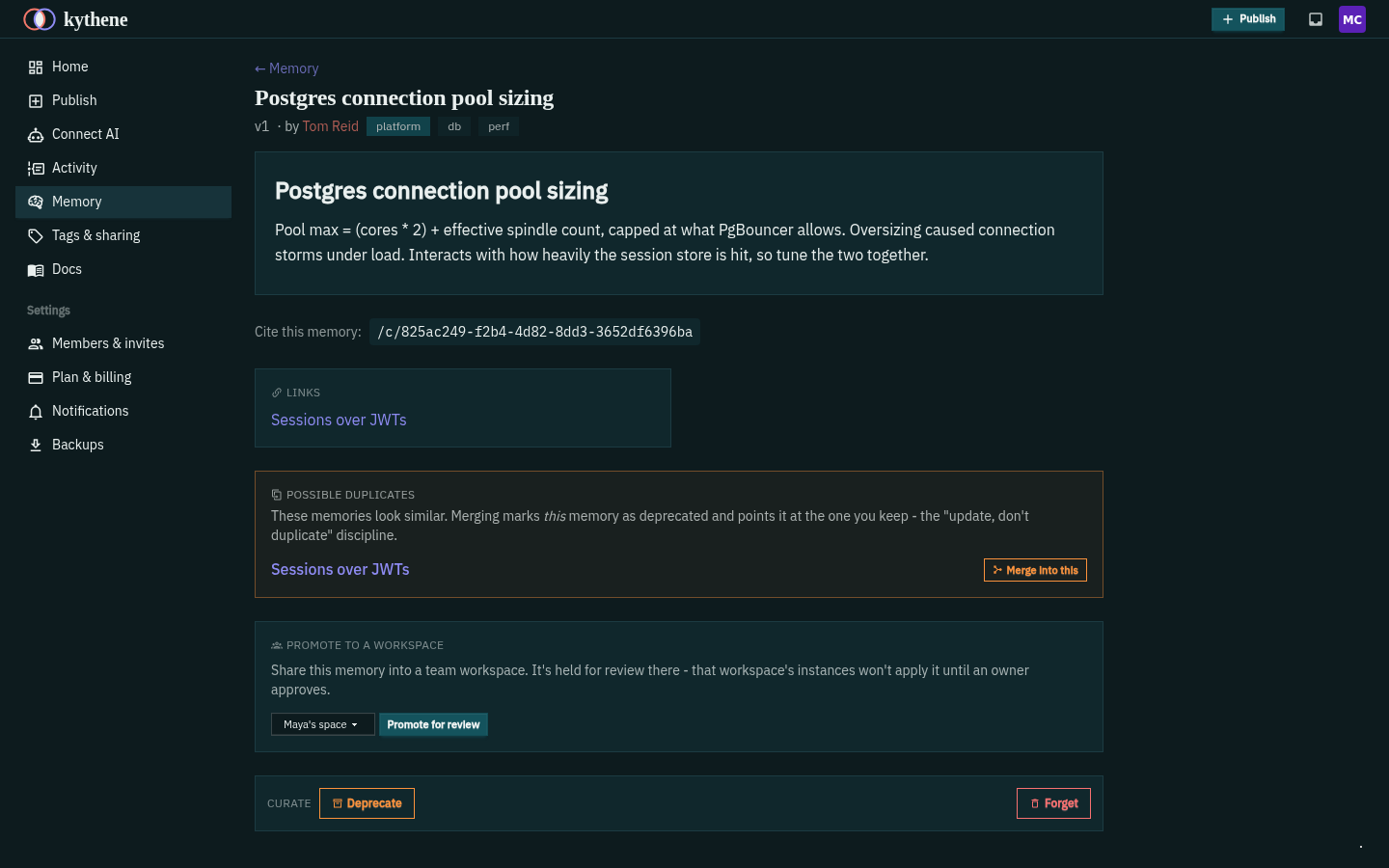
Every memory is written as markdown and rendered as markdown - headings, lists, code, the lot - so it reads properly instead of arriving as a wall of escaped text. That difference is the whole point: it's knowledge, not a string.
And it carries everything you'd want to trust it: what it is, how it relates to other memories, who wrote it, and whether it's still current.
Search, not browse
Recall runs full-text search across every memory, and blends in semantic matching - on for the hosted service, and on self-host once you configure an embedding server - so the right memory surfaces even when your words don't match its words.
Typed
A light classifier - decision, how-to, gotcha, reference, person, meeting - so a memory is more than a blob. Filter recall by type when you want just the decisions.
Linked
Drop a [[wikilink]] in a memory and it connects automatically. The result is a graph of related knowledge, not a flat list.
Provenance and citation
Every memory records the human who wrote it and the instance that produced it, and carries a citable link - so an AI output can point at the memory it relied on.
Staleness handled
Deprecate a memory when it's superseded and recall stops surfacing it, so your instances stop applying stale knowledge. It stays retrievable for audit, and can point at what replaced it.
Kept current
Re-use a title within a project and the memory is superseded rather than duplicated. Knowledge moves forward instead of piling up in contradictory copies.
The loop
Start caught up
Your instance recalls the project's memory in one call at the start of a session.
Capture what's worth keeping
A decision, a how-to, a gotcha - written as markdown, scoped to the project.
Share it with the team
Promote it into a team workspace, where an owner reviews it before it goes live.
One loop, three resting places
Publish the work, agree what's true, and your instances act on it.
Work in flight
A draft, a result, a report - published, versioned and reviewed block by block.
What the team settled
The durable pages, in a tree a person can browse - written by your assistants, approved by you.
What the AI applies
The agreed thing, recalled in the flow of work by every teammate's instance. You are here.
Give your team one memory - and a say in what goes in it.
Written and recalled over MCP, by every instance on the team. It's free to start.
See the full feature list, pricing, or Kythene vs Obsidian.