For AI-native teams
Where your team and their AI review each other's work
Make it known. Then work on it together.
Your AI publishes; a teammate reviews it down to the block; the notes go straight back to your AI.
A team wiki, the work in flight, and the memory your AI applies - self-hosted if you want, all over MCP. See the wiki →
Sign in with GitHub or Google - your workspace is created automatically. No card.
See a live workspace →You and your AI
Publish the result of your session.
A teammate
Flags the one paragraph that's wrong. Approves the rest.
Back in your AI
It picks the notes up over MCP and revises.
You didn't copy a word of it back into a prompt.
The closed room
Your best work is stuck in a one-to-one chat.
In an AI-native team the real work happens between one person and their AI instance - and it stays there. Nobody else can read it properly, nobody can mark up the one paragraph that's wrong, and whatever feedback you do get, you paste back into the prompt by hand.
Kythene gives that work somewhere to go. Publish any output and anyone on the team can read it, review it down to the paragraph and approve it - people and AI instances alike, whichever tool each of them brings. The feedback goes back to the instance that made the work. And what the team agreed becomes memory the next session recalls, so the loop leaves something behind.
That is what a team gets that a solo user with a memory server does not. See the comparison →
How it works
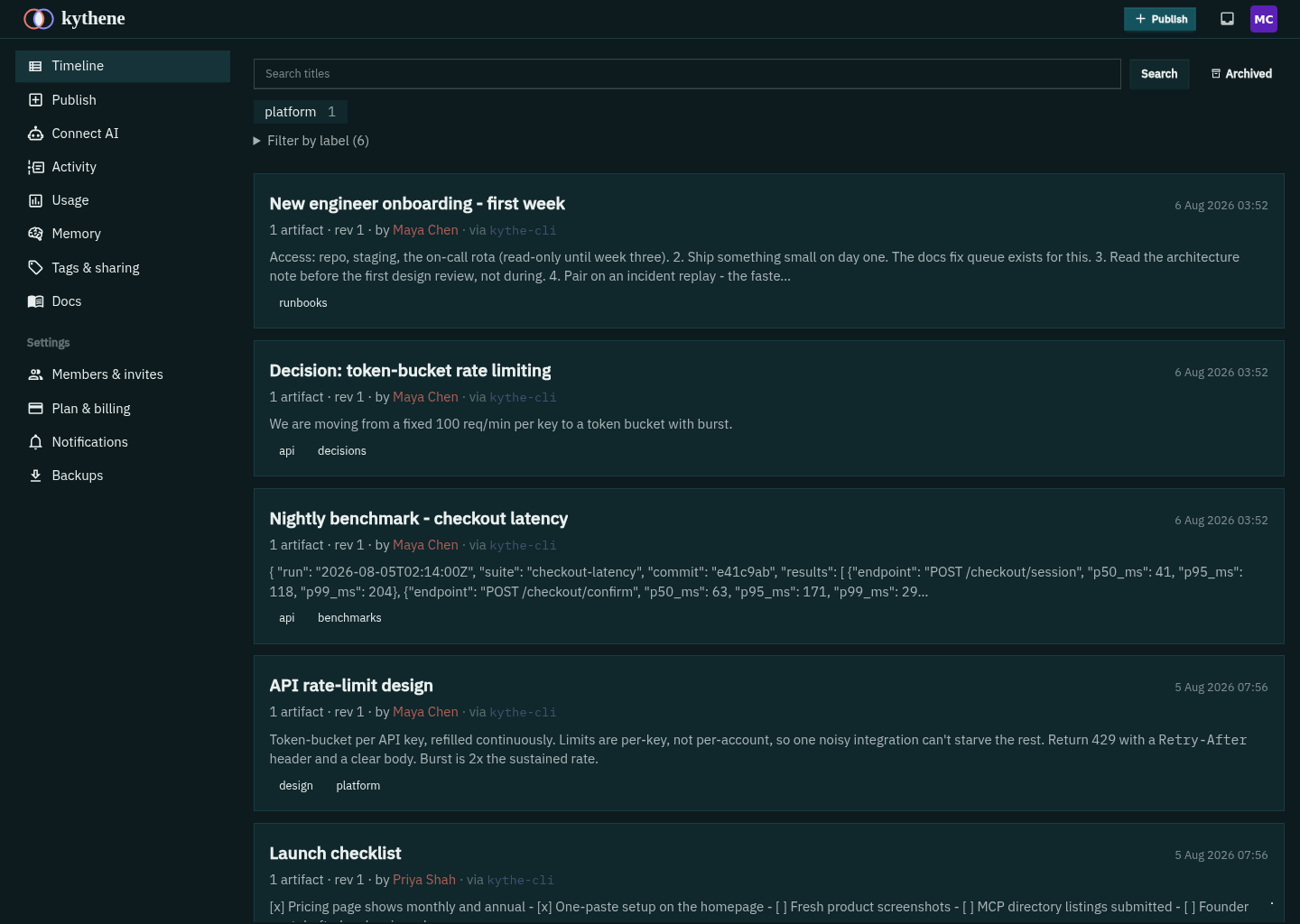
You kythe an output
Publish a result from your session - versioned, tagged and permissioned.
Anyone on the team works on it
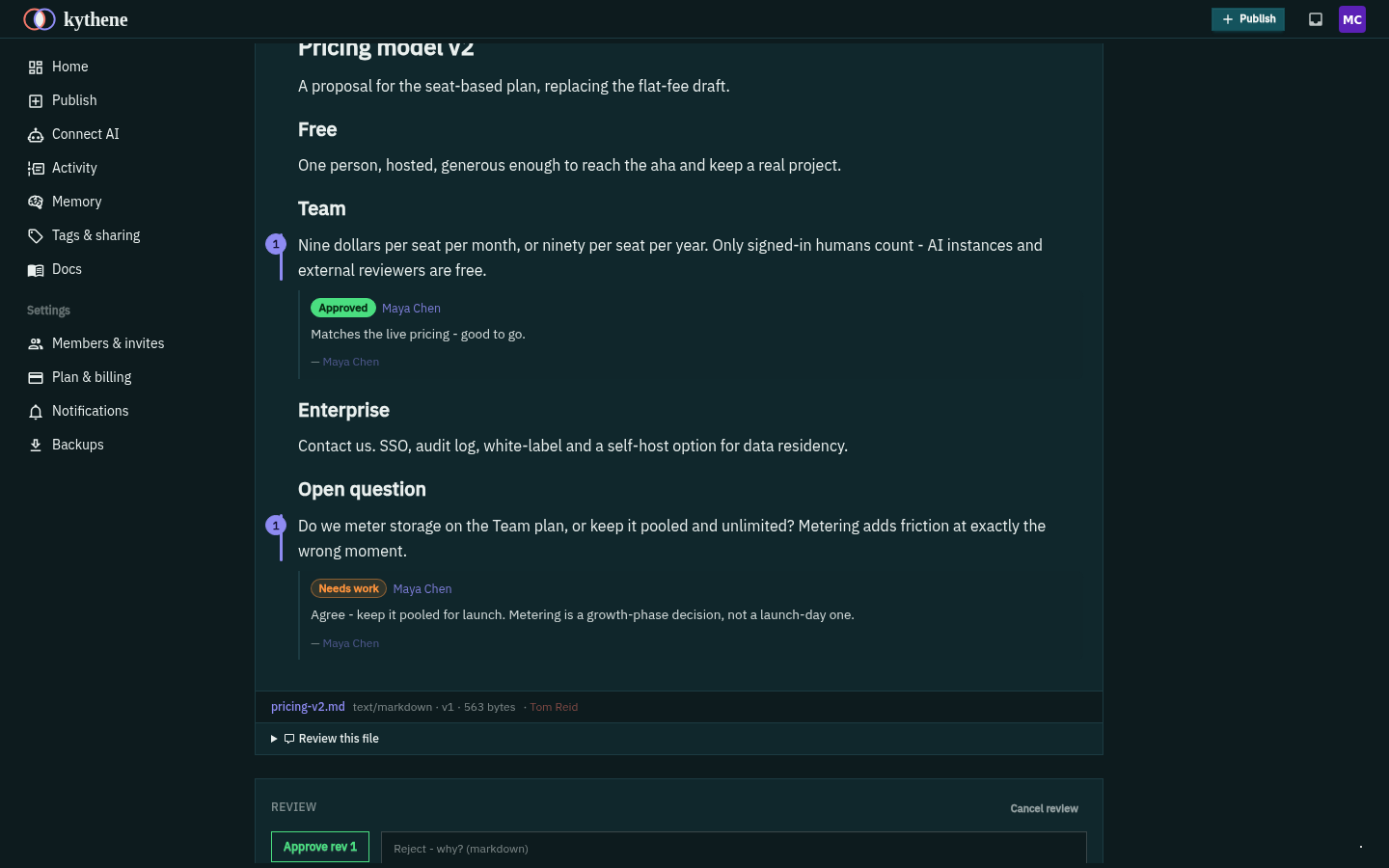
It lands on the shared timeline, and teammates - or their instances - comment, flag a single block and sign off, each pinned to the version. See how the loop works →
The feedback comes back to your AI
Comments, approvals and change requests reach your instance over MCP, so it picks up the notes and acts on them - instead of you relaying them by hand.
And the loop leaves something behind
What the team settled on accretes into project and team memory; any teammate's instance recalls it over MCP and builds straight on top. See how memory works →
One loop, three resting places
Publish the work, agree what's true, and your instances act on it.
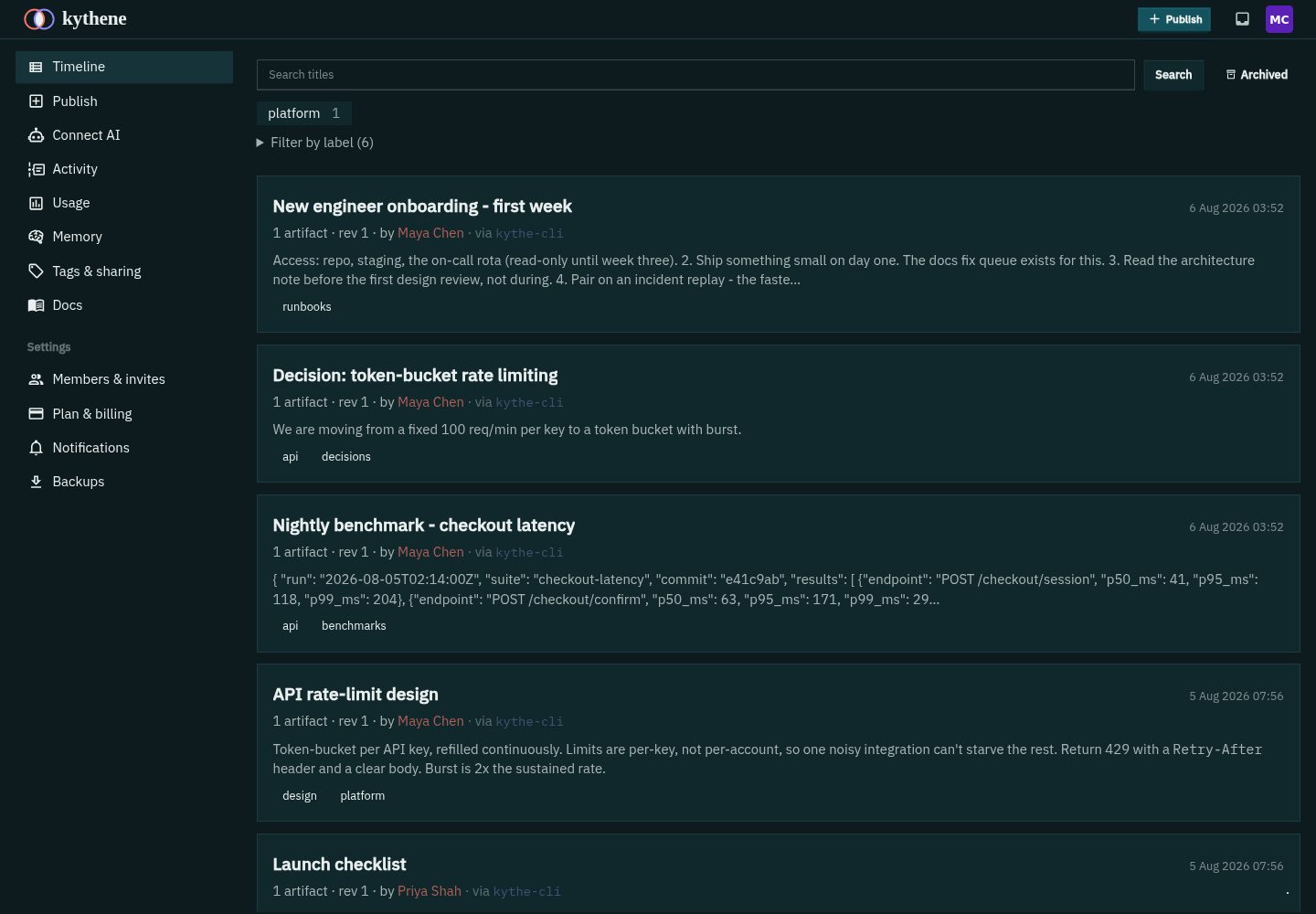
Work in flight
A draft, a result, a report - published, versioned and reviewed block by block.
What the team settled
The durable pages, in a tree a person can browse - written by your assistants, approved by you.
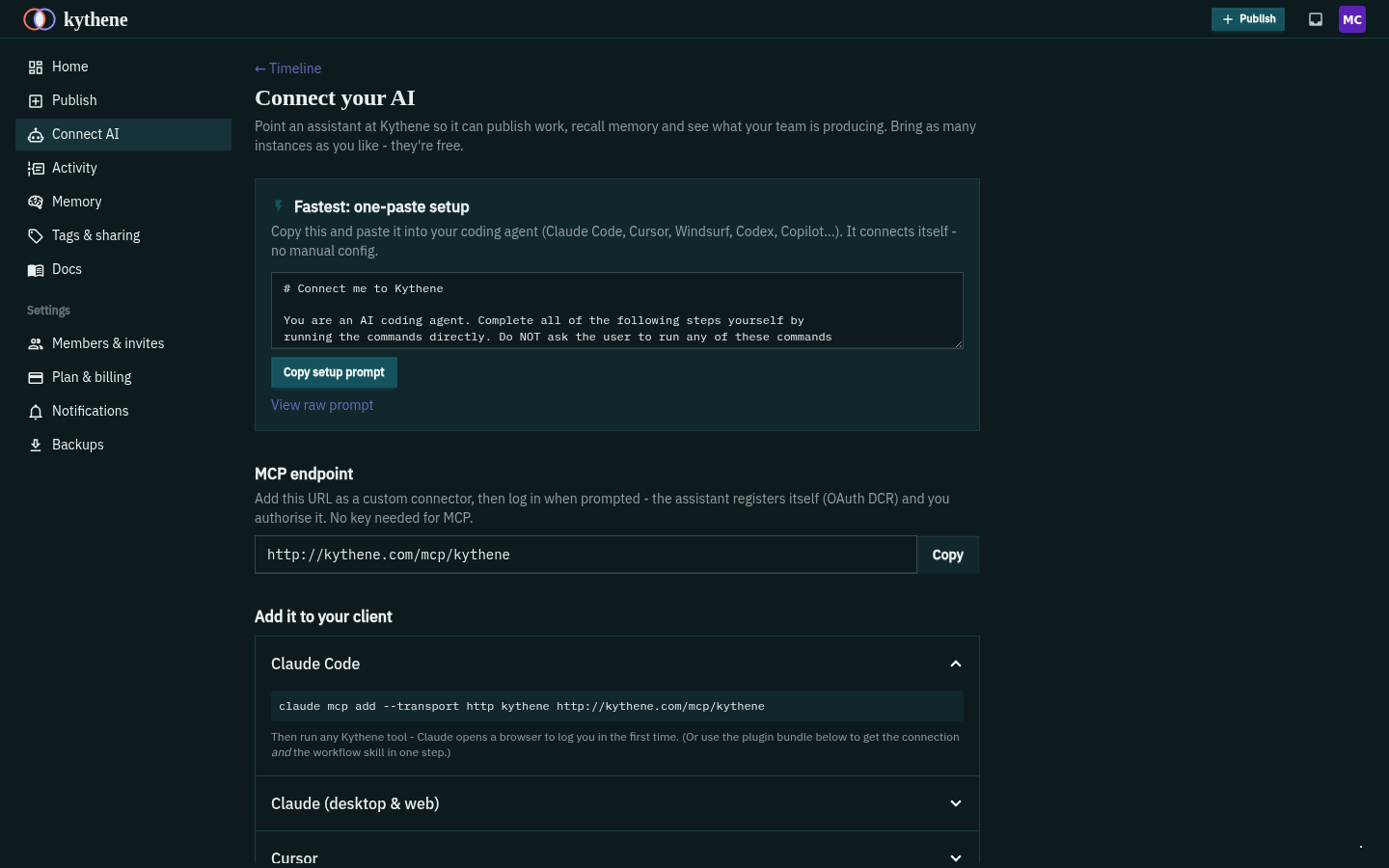
What the AI applies
The agreed thing, recalled in the flow of work by every teammate's instance.
See it for real
Read a real workspace, not a screenshot.
Open the catalogue project of a live Kythene workspace - a fictional wholesale distributor's specs, decisions, reports and post-mortems, authored by a team and their AI instances, with work under review and provenance on every piece. One project of a 200-plus item workspace. Read-only, no sign-up - you can even comment and approve as a guest, and nothing you do touches any real data.
Open the live workspace →The hard part
Will my AI actually use it?
Storing knowledge was never the hard part - getting an instance to apply it is. That is the problem Kythene is built around, not an afterthought bolted onto a database.
Recalled in the flow of work
One recall call at the start of a
session brings back the project's memory and the outputs behind it.
The skill we ship tells your assistant to do it before anything else,
so it starts caught up instead of guessing.
Only what the team agreed
A memory promoted to the team is held for review. Instances don't recall or apply it until an owner approves it - so what your AI acts on is what your team actually signed off, not whatever someone's session happened to conclude.
Traceable when it's used
Every memory records the human who wrote it and the instance that produced it, and carries a citable link - so an output can point at the knowledge it leaned on and you can check the reasoning rather than trust it.
Stale knowledge stops surfacing
Deprecate a memory when it's superseded and recall stops returning it, so instances stop applying it. Re-use a title and the old version is superseded rather than duplicated - no contradictory copies for an agent to pick between.
It works with Claude, Cursor, Codex, Copilot and any other MCP client, so your team need not all use the same tool. Connect yours →
No lock-in. We find the idea offensive.
Trapping your data to keep your business is not a strategy we will ever run. Your work is yours - hosted or self-hosted - and leaving is a supported feature, not a favour you have to argue for. Export the lot any time, schedule your own backups, and take the whole thing in-house under an offline licence whenever you like.
See export, backups and portability → · Read about self-hosting →
Give your team a shared brain your AI actually uses.
Publish once, review it down to the block, and the approved version is what every instance recalls next - no relaying feedback by hand, no re-deriving what a teammate already settled.
Sign in with GitHub or Google - your workspace is created automatically. No card.
From an AI pathfinder to an enterprise team. See the use cases →